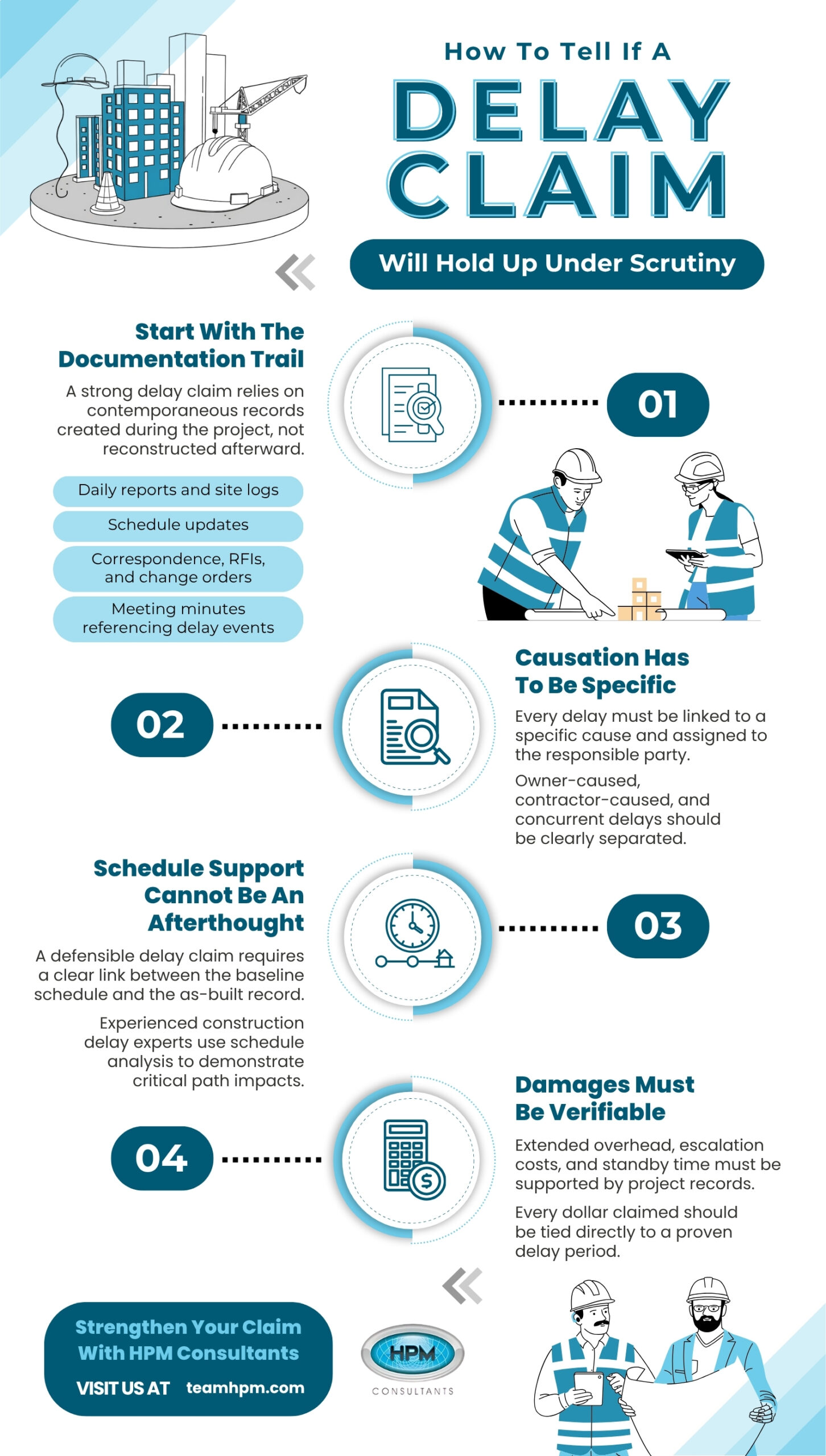


A well-prepared delay claim is more than a statement of lost time—it is a carefully documented case supported by evidence, schedule analysis, and verifiable costs. Whether you are a contractor, owner, or project manager, ensuring your claim can withstand scrutiny requires a structured and fact-based approach.
1. Start with a Strong Documentation Trail
The foundation of every successful delay claim is accurate, contemporaneous project documentation. Records created during the project carry far more credibility than information reconstructed after completion.
Essential documentation includes:
- Daily reports and site logs
- Schedule updates
- Correspondence, RFIs, and change orders
- Meeting minutes referencing delay events
Maintaining organized records helps establish when delays occurred and how they impacted project progress.
2. Clearly Establish the Cause of Delay
Every delay must be linked to a specific event and assigned to the responsible party. A defensible claim clearly identifies whether the delay was:
- Owner-caused
- Contractor-caused
- Concurrent (shared responsibility)
Separating these causes ensures accountability and strengthens the credibility of the claim.
3. Support Your Claim with Schedule Analysis
Schedule analysis is essential for demonstrating how a delay affected the project’s critical path. A strong claim connects the baseline schedule with the as-built schedule to show measurable impacts on project completion.
Experienced delay consultants use professional scheduling techniques to prove the relationship between delay events and overall project performance.
4. Verify All Claimed Damages
A delay claim is only as strong as the evidence supporting its financial impact. Costs such as extended overhead, labor escalation, equipment expenses, and additional project time must be backed by project records and financial documentation.
Every dollar claimed should be directly tied to a proven delay period and supported with clear evidence.
Build a Stronger, More Defensible Delay Claim
Successful delay claims rely on detailed documentation, accurate schedule analysis, clearly identified causation, and fully supported damages. By following these principles, project teams can present claims that stand up to technical review, negotiations, and dispute resolution with greater confidence.