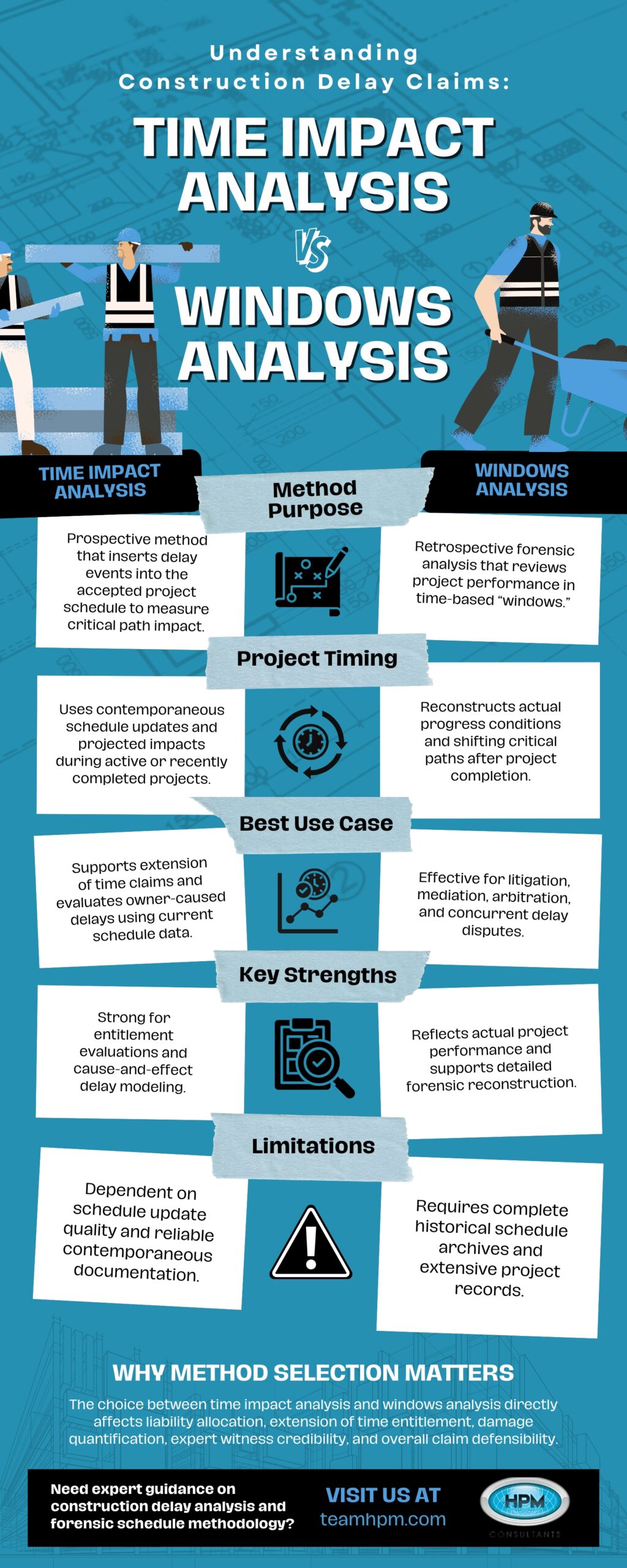


In construction projects, delays can significantly impact schedules, costs, and contractual obligations. Choosing the right method for analyzing these delays is crucial for effective claims management and dispute resolution. Two primary methods—Time Impact Analysis (TIA) and Windows Analysis—offer distinct approaches with unique advantages and limitations.
Method Purpose
- Time Impact Analysis: A prospective method that integrates delay events into the accepted project schedule to measure their effect on the critical path.
- Windows Analysis: A retrospective forensic method that examines project performance in specific time-based “windows” after project completion.
Project Timing
- Time Impact Analysis: Utilizes contemporaneous schedule updates and projected impacts during active or recently completed projects.
- Windows Analysis: Reconstructs actual progress conditions and tracks shifting critical paths after project completion.
Best Use Case
- Time Impact Analysis: Ideal for supporting extension of time claims and evaluating owner-caused delays using current schedule data.
- Windows Analysis: Effective for litigation, mediation, arbitration, and resolving concurrent delay disputes.
Key Strengths
- Time Impact Analysis: Excels in entitlement evaluations and cause-and-effect delay modeling.
- Windows Analysis: Reflects actual project performance and allows for detailed forensic reconstruction.
Limitations
- Time Impact Analysis: Relies heavily on the quality of schedule updates and reliable contemporaneous documentation.
- Windows Analysis: Requires complete historical schedule archives and comprehensive project records.
Why Method Selection Matters
The choice between Time Impact Analysis and Windows Analysis directly impacts:
- Liability allocation
- Extension of time entitlement
- Damage quantification
- Expert witness credibility
- Overall claim defensibility
Selecting the appropriate method ensures that delay claims are accurate, defensible, and aligned with project realities.